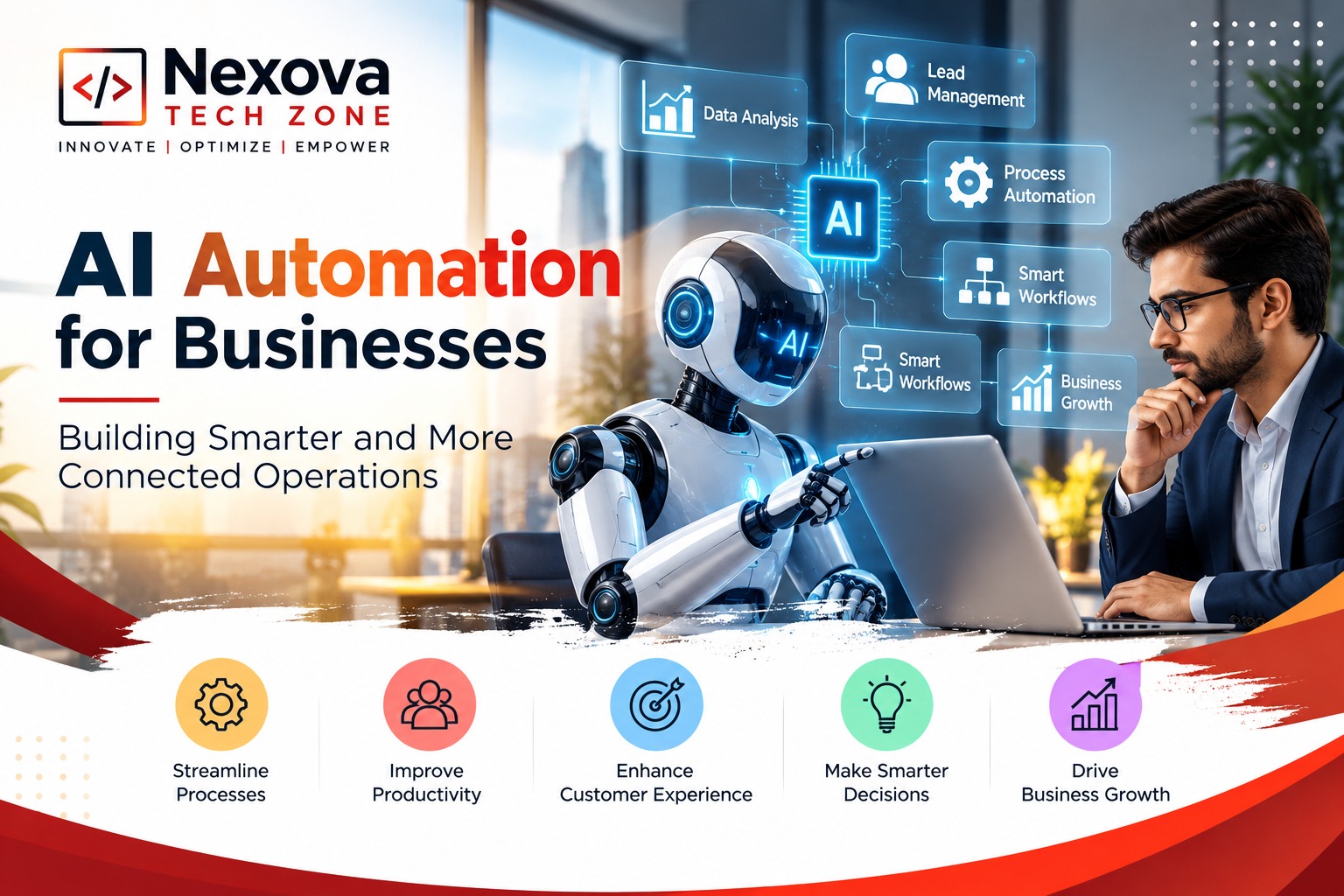
AI Automation for Businesses: Building Smarter and More Connected Operations

Businesses are increasingly adopting AI-driven technologies to modernize their operations.. Companies are no longer using artificial intelligence only for chatbots or content generation. AI is increasingly being connected with websites, CRM platforms, internal applications, databases, communication tools, and other business systems.
This shift allows organizations to create connected digital processes where information can move between systems, be interpreted by AI, and trigger the next appropriate action.
For businesses looking to improve operational efficiency, the opportunity is not simply about adding another AI tool. It is about finding practical ways to connect people, data, software, and processes.
**Understanding AI Automation in Business **
AI automation brings intelligent technologies and automated software processes together to streamline selected business operations.
A conventional software system usually performs actions according to predefined instructions. AI introduces an additional capability: it can work with information that may require interpretation.
For example, an online business may receive hundreds of customer enquiries through its website. Instead of sending every enquiry to the same employee, an AI-powered system can examine the message, understand its general purpose, organize the information, and send it into the appropriate business process.
The final workflow can still include employee review wherever it is necessary.
Unlike a standalone AI chatbot, AI automation can be integrated directly into broader business workflows.
**Where AI Automation Can Support Businesses **
Every organization has different processes, so there is no single automation model that works for everyone. However, several areas can benefit from intelligent technology.
**1. Sales Operations **
Sales teams often work with information arriving from websites, email campaigns, social media, online forms, and other channels.
An AI-enabled workflow can help organize incoming information and transfer relevant details into a CRM system. It can also assist with enquiry classification, lead summaries, follow-up preparation, and internal notifications.
As a result, marketing and sales teams can work through a more integrated and coordinated workflow.
**2. Customer Communication **
Businesses receive many questions that follow similar patterns.
AI-powered systems can help identify the nature of an enquiry, retrieve information from approved business sources, prepare a response, and pass unusual cases to a support employee.
This approach can be useful for businesses that need to manage a large volume of customer communication while maintaining a clear human escalation process.
**3. Business Documents **
Invoices, applications, forms, reports, contracts, and other documents often contain valuable information in different formats.
AI document processing can help identify relevant fields, classify documents, summarize information, and prepare structured data for another application.
Instead of treating every document as a manual data-entry exercise, organizations can create a workflow around the information contained inside those documents.
**4. Internal Knowledge Management **
Employees frequently need information from company documents, policies, product information, project records, and internal resources.
An AI knowledge assistant can provide a conversational interface for finding relevant information from approved sources.
For example, an employee could ask a question about an internal process and receive an answer based on the company's available documentation rather than manually searching through multiple folders or applications.
**5. Connecting AI With Existing Software **
One important aspect of AI workflow automation is integration.
Businesses already use applications for accounting, customer management, communication, project management, inventory, HR, marketing, and other functions. Replacing all these systems simply to introduce AI is not always practical.
Instead, AI can often be introduced as an additional intelligence layer around existing applications.
APIs, databases, workflow platforms, web applications, and business software can be connected to create a flow of information between different parts of an organization.
**For example: **
Customer Enquiry → AI Analysis → CRM Update → Team Notification → Human Follow-Up
The exact architecture depends on the business requirements, existing technology, security considerations, and type of information being processed.
**Why Data Quality Matters **
AI automation depends heavily on the information available to it.
If business records are incomplete, outdated, duplicated, or inconsistent, an automated system may produce unreliable results. For this reason, organizations should examine their data before implementing complex business automation.
**Important considerations include: **
- Where the information is stored
- Who is allowed to access it
- Whether the data is current
- Which sources are approved
- How information moves between systems
- What should happen when information is missing
A strong technical foundation can make an AI implementation easier to maintain and improve.
**Human Control Remains Important **
AI can assist with many operational activities, but businesses still need to determine where people should remain involved.
Some workflows may allow AI to prepare information or recommend an action, while an employee makes the final decision.
For example, an AI system could review a customer request and prepare a response, but a team member may approve the message before it is sent.
This type of design creates a balance between automation and human responsibility. Current enterprise AI implementations increasingly emphasize permissions, review points, exception handling, and governance rather than unrestricted automation.
**A Practical Approach to AI Adoption **
Businesses considering AI solutions for businesses can begin by examining their existing operations.
Instead of asking, “Where can we add AI?”, a more useful question is:
“Which area of your business could benefit from smarter technology and more efficient information management?”
The answer may be found in customer communication, reporting, document management, sales operations, internal knowledge, or another area.
Once a suitable process has been identified, the business can define the required inputs, expected outputs, software integrations, security requirements, review points, and success measurements.
This creates a more structured foundation for developing an AI-powered solution.
**The Next Stage of Business Technology **
AI automation is gradually becoming part of the broader digital transformation landscape. Its value comes from connecting intelligence with actual business processes rather than treating AI as an isolated technology.
Organizations that carefully combine AI technology, software integration, business data, automation, and human expertise can create systems that are more connected and responsive.
The focus should be on finding practical areas where intelligent solutions can make everyday operations more efficient. With the rapid development of AI technologies, organizations will have increasing opportunities to
**Building AI-Powered Business Solutions **
At Nexova Tech Zone, we work with businesses to explore technology solutions across AI automation, custom software development, AI applications, workflow solutions, and digital transformation.
If your organization has a repetitive or disconnected business process that could benefit from intelligent technology, the first step is understanding the existing workflow and identifying where AI can provide practical value.
Nexova Tech Zone — Innovate | Optimize | Empower